
3 Questions to Ask Before Implementing AI in Business
Before investing in artificial intelligence, business leaders must answer three operational questions: what tasks are performed repeatedly, where are revenue opportunities being lost to friction, and…
- AI Strategy
- Business Automation
- Operational Efficiency
- Lead Management
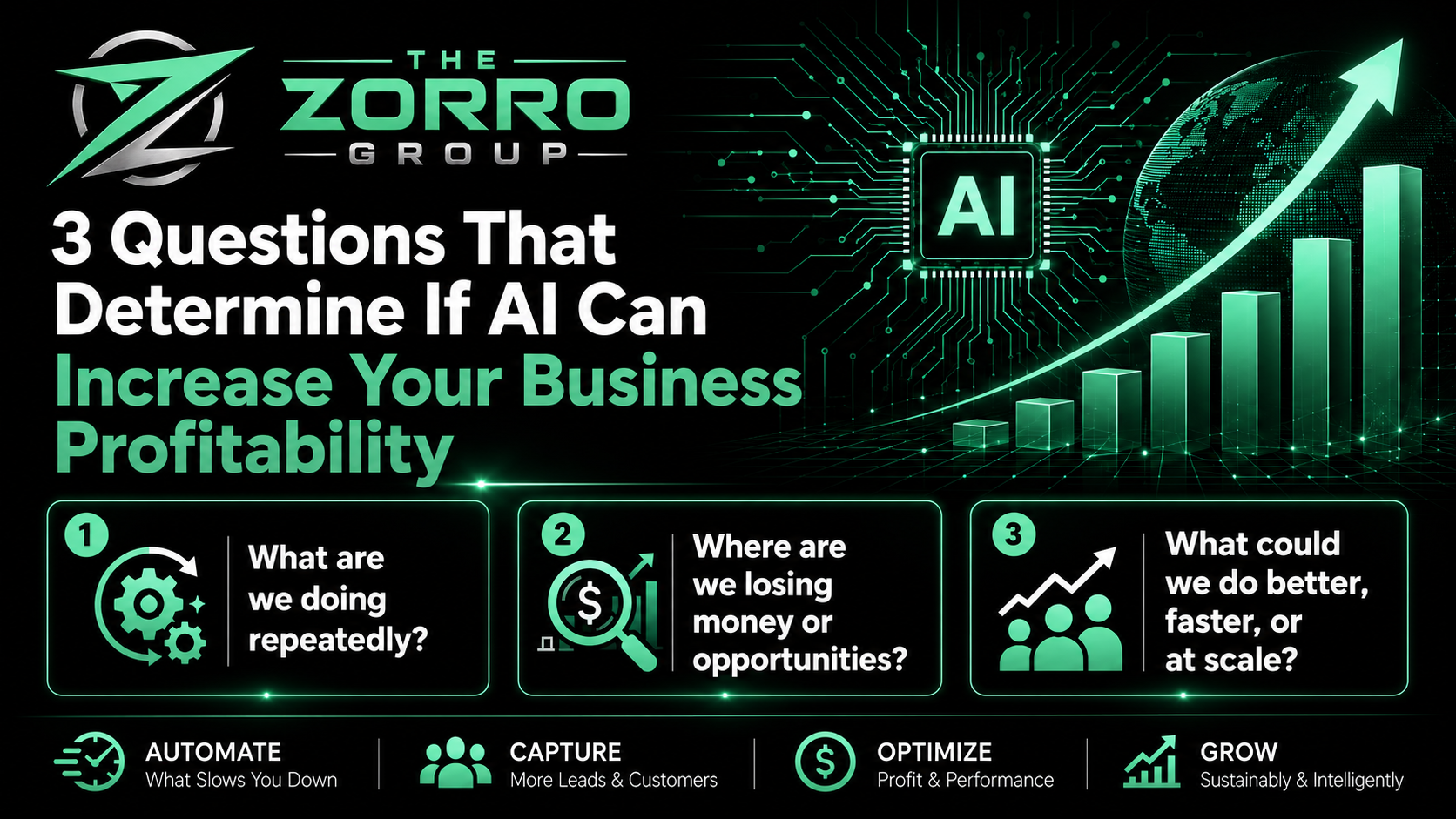
Before investing in artificial intelligence, business leaders must answer three operational questions: what tasks are performed repeatedly, where are revenue opportunities being lost to friction, and what workflows need to scale immediately. Applying AI to solve defined operational bottlenecks—rather than adopting technology for its own sake—is the fastest way to reduce overhead and generate measurable profitability. At The Zorro Group™, our core platform, The Response Desk™, is engineered around this exact approach.
What tasks are your teams performing repeatedly?
High-volume, repetitive workflows represent the lowest-risk, highest-return starting point for business AI. When skilled employees spend hours managing routine administrative duties, operational costs increase while overall capacity stalls.
Common repetitive tasks suited for automation include:
- Answering standard customer service and sales inquiries
- Scheduling appointments and updating calendar records
- Entering lead data across multiple internal systems
- Dispatching routine follow-ups and appointment reminders
Automating these steps through an intelligent marketing engine eliminates manual data entry and routine follow-up delays, allowing your team to focus on high-value client interactions.
Where is operational friction costing you revenue?
Revenue loss often hides in everyday communication gaps and dropped leads. Every missed phone call, slow response to an inquiry, or neglected follow-up directly reduces business profitability.
Evaluate where friction occurs across your customer journey:
- Inbound calls missed during peak business hours or after hours
- Delays between an inbound lead submission and initial outreach
- Leads that stall in the pipeline because staff lack time for persistent follow-up
Deploying automated AI call center agents provides 24/7 call handling and immediate missed-call recovery, ensuring that prospective revenue is captured rather than lost to competitors.
What operational workflows need to scale faster?
AI adoption should not simply replace existing labor; it should expand what your organization can accomplish. Identifying your capacity limits reveals where technology provides a distinct competitive advantage.
Consider whether your current infrastructure allows you to:
- Engage and qualify every inbound lead within seconds
- Deliver round-the-clock service across phone, text, and web channels
- Maintain consistent follow-up across thousands of prospects simultaneously
Leveraging specialized platform technology allows businesses to scale operational capacity and service volume without a linear increase in staffing costs.
Focus on profitability before selecting AI tools
A practical AI strategy never starts with asking where AI can be applied. The correct question is where AI will make the business more profitable.
A disciplined deployment follows a clear sequence:
- 1Pinpoint the operational bottleneck or revenue leak.
- 2Implement targeted automation to resolve that specific friction point.
- 3Track business impact and conversion metrics through clear data and reporting dashboards.
Build your practical AI roadmap
The most successful AI deployments focus on measurable operational and financial returns. To identify where automated agents and intelligent workflows can eliminate bottlenecks in your organization, contact our team to schedule a walkthrough.
Frequently asked questions
- What is the first step in adopting AI for a business?
- The first step is auditing internal operations to identify repetitive tasks, delayed customer responses, and lost revenue opportunities. Applying AI directly to an established bottleneck delivers faster returns than deploying tools without a defined problem.
- How does AI improve business profitability?
- AI drives profitability by reducing the labor hours spent on manual administrative tasks, capturing missed revenue through instant 24/7 response times, and enabling businesses to handle higher inquiry volumes without increasing headcount.
- What business processes are best to automate first?
- The most effective starting points for automation are high-frequency, standardized workflows such as answering inbound phone calls, qualifying leads, managing calendar scheduling, and executing routine follow-up sequences.
See what your own missed opportunities are worth
We'll walk your call flow, show where leads leak and what The Response Desk™ recovers.
Share this article
Every link points back to thezorrogroup.com and is tagged so the visit shows up in your analytics.
https://thezorrogroup.com/insights/3-questions-to-ask-before-implementing-ai-in-business?utm_source=linkedin&utm_medium=social&utm_campaign=insightsHook, key takeaways and the tracked link — paste straight into LinkedIn or Facebook.
3 Questions to Ask Before Implementing AI in Business

Before investing in artificial intelligence, business leaders must answer three operational questions: what tasks are performed repeatedly, where are revenue opportunities being lost to friction, and…

• Answering standard customer service and sales inquiries
• Scheduling appointments and updating calendar records
• Entering lead data across multiple internal systems

What is a missed lead actually costing you?

Read the full article: https://thezorrogroup.com/insights/3-questions-to-ask-before-implementing-ai-in-business?utm_source=linkedin&utm_medium=social&utm_campaign=insights